90%+ of the people who visit your website leave without filling in your form.
Give them something they will fill in.
Most homeowners who visit a “we buy houses” website aren’t ready to give you their phone number and wait for a sales call, so they leave. The Home Sale Forecast is a section you add to your website that gives them a free report on their own house: what it is worth, how long it would take to sell, and what they would walk away with. All they enter is their address and email. You get the lead, and Humphrey, the AI assistant built into Apex Vivus, follows up with short, friendly emails until they are ready to talk.
Not all motivated sellers are ready to sell now.
A motivated seller isn’t defined by whether they want to, need to or have to sell their house. A motivated seller is defined by how willing they are to sell it below market value. Plenty of them land on your website. Not all of them are ready to sell today.
Many of them come to your website just to get a feel for it: how selling to a cash buyer works, what they might get and how long it would take. Some aren’t ready to sell yet. Others are ready, but want nothing to do with the pressure that comes with selling. To both, a form for a no-obligation cash offer reads like a high-pressure car salesperson: pushing for an appointment, a high-pressure follow-up nightmare, an answer to the offer and a walkthrough, as soon as possible.
So they look around and leave without leaving anything behind. No email, no phone number, nothing for you to follow up on.
The Home Sale Forecast catches them while they’re still figuring it out. They get the answers they came for, and you get their address and email, so you can follow up when they’re ready.
To a seller, a form feels like a commitment.
They see a form as an obligation to set an appointment, to talk to people, to make a decision, and to sell their house. That is very intimidating when you’re not 100% sure how the process works, or when you’re not 100% sure you’re ready to sell.
Being motivated to sell doesn’t mean they want to be forced into a commitment and a decision right now. So they leave, and you never knew they were there.
Real estate websites typically turn 1 to 5% of visitors into leads (Sierra Interactive).“If you’re not yet ready to sell,
grab one of these.”
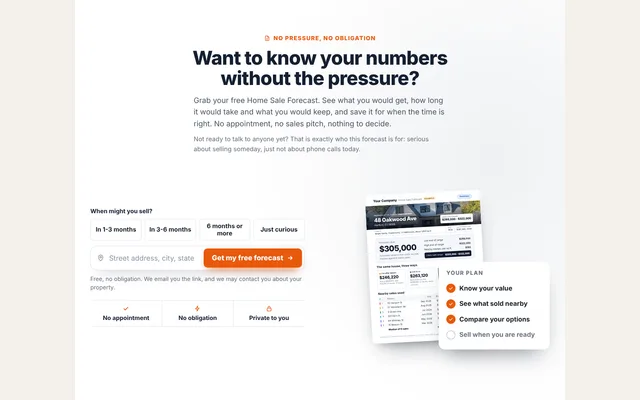
That’s the idea behind the Home Sale Forecast. It gives sellers more information without the commitment hanging over their head: no appointment to schedule, no car salesperson on the phone, no being forced to make a decision, no being pushed towards selling. Just a clear prediction of how their sale would go.
The seller gets a free report on their house.
You get the lead.
A seller on your website types in their address and email, and within seconds their free report on their own house opens. Four quick questions about the condition come first (or they send photos instead), because a price means little until the condition is known. Then it shows what the house is worth, how long it would take to sell, what similar homes nearby sold for, and how much money they would really walk away with. Nobody calls them, so they feel safe asking. Here is what the report shows them.
What their house is worth
An estimated price range for their house, based on homes that recently sold near them.
How long a sale would take
How long homes near them take to sell with an agent, next to selling to you for cash on the date they choose.
What the neighbors sold for
Homes like theirs that sold nearby, with the address and the price each one sold for.
How much they would really keep
What is left of a listing price after the agent’s commission, closing costs, repairs and months of payments, next to selling to you as-is.
The more questions they answer, the more the report shows them. Tell it about the condition of the house and their plans, and it adds a repair estimate, their best way to sell, and a written plan they can download. Every answer is also saved on their lead in your CRM, so you know their situation before you ever talk.
More than a name and an email address.
You know who you are calling before you call.
A regular “we buy houses” form gives you a name and a phone number, and you learn everything else on the first call. With the Home Sale Forecast, much of that is already on the lead before you pick up the phone.
The house
The address, with its estimated value and the sales around it already looked up.
Their timeline
When they think they might sell: in 1–3 months, 3–6 months, 6 months or more, or just curious.
Their situation
Their answers about the condition of the house and their plans, saved as notes on the lead.
The right moment
An email when they come back to your website, so you reach out while they are paying attention.
It doesn’t stop at the report.
Every lead is followed up for you.
Every homeowner who gets a report is saved as a lead in the CRM that comes with your Apex Vivus website. When they come back to your website, you get an email. Humphrey, the AI assistant built into Apex Vivus, writes a short, friendly follow-up for you, so they hear from you at the right moment instead of being chased.
They enter their address and email, and the report opens in seconds. Four quick questions about the condition come before any number.
In your CRM, with when they think they might sell: soon, or months away.
They visit your website again, or open their report after two weeks or more.
Who came back, what they looked at, and when they said they might sell.
A short, friendly email signed with your name. The moment they say they are ready or ask for your offer, he stops and emails you that they are ready to talk.
Some homeowners want to talk today.
Others want their numbers first.
“Call me. What would you pay for my house?”
They’re ready for a call and a walkthrough. Your website’s offer form, or Instant Offer, where they send photos of the house and get an offer range back, puts them in front of you today.
Saved on the lead as: ready now“What would I get? Just don’t push me.”
They want the same answer, without being called, pushed into a walkthrough or rushed into a decision. The forecast gives them their numbers, and Humphrey keeps in touch calmly, so when they’re ready to talk, you’re the one they already trust.
Saved on the lead as: 1–3 months, 3–6 months, 6+ months or just curiousEvery design says the same thing.
No pressure.
Each one offers the forecast in a different way, so it fits your site and the seller you’re speaking to. Click any design to see it full size.
Showcase7 designs
They see what the forecast looks like before they give an email: its real pages, with example numbers. Nothing is hidden, so nothing feels like a trap.


On their schedule4 designs
Tells the seller there is no rush. They pick their own timing, and you follow it.


The forecast itself4 designs
Shows the real pages. Seeing the work up front is what makes a skeptical seller trust it.


Simple2 designs
One calm invitation, anywhere on the page.


Fifty cents per report.
Free for a house looked up in the last 30 days.
A forecast uses 5 credits ($0.50) each time its property data has to be looked up: when it is first made, and again when the seller opens it a month or more later and it refreshes with the latest sales.
For each new report, and for each refresh after 30 days, paid from your Apex Vivus credit balance.
When the same house was already looked up in the last 30 days.
Every homeowner is saved as a lead, even if your balance runs out. Their report finishes as soon as you add credits.
Good to know.
What is the Home Sale Forecast?
A section on your website where a homeowner types their address and email and gets a free prediction of how their sale would go: what the house is worth, what sold nearby, how long a sale would take with an agent compared with selling for cash, and what they would walk away with each way.
How is that different from a form?
A form only asks for an address and a phone number, but to a seller that feels like signing up for calls, a walkthrough and a push for a decision. The forecast asks for an email in exchange for answers they can keep. No call, no appointment, no pressure. You still get the address, their email, their name and mobile number when they choose to give them (both are optional on the form) and, on the designs that ask "When might you sell?", when they think they might sell.
Why would a seller trust this more than a form?
Because they get something useful first, and they don't have to talk to anyone to get it. They see their likely sale range, what sold nearby and what they would keep, on their own time. When you do reach out, it is to someone who has already seen you be helpful instead of pushy.
What about sellers who are ready to talk now?
They can. On investor and wholesaler websites every forecast has a button to ask for your cash offer, and your regular offer form and Instant Offer stay on the page too. The forecast adds the sellers who want their numbers without the pressure, the ones who would otherwise leave.
What happens after they get their forecast?
They are saved as a lead in your Apex Vivus CRM with their timeline. When they come back to your website, or open their forecast again after two weeks or more, you get an email. Humphrey writes a short, low-pressure follow-up for you, and you choose whether each one waits for your approval or goes out on its own. When they say they want to sell as soon as possible or ask for your cash offer, Humphrey stops and you get one "ready to talk" email. A seller who says "in 1 to 3 months" is planning, not asking for a call, so Humphrey keeps in touch and checks in after 30 days.
Does the forecast stay current?
Yes. When a seller opens their forecast a month or more later, it refreshes with the latest nearby sales, so it stays a reason to come back. A refresh is a new lookup, so it uses another 5 credits ($0.50) when the data has to be looked up again (free when that house was looked up in the last 30 days). Nothing is refreshed for sellers who never open it, so there is no spending in the background.
Will Humphrey ever pester my leads?
No. Follow-ups are email only, never more than one a week per seller, only during daytime hours in the seller's state, and never to anyone who unsubscribed or asked not to be contacted. Every email carries your postal address and an unsubscribe link.
What does it cost?
A forecast uses 5 credits ($0.50) from your Apex Vivus wallet when the property data has to be looked up, and the same again when it refreshes after 30 days. A house already looked up in the last 30 days is free. With no credits left the seller is still saved as a lead and told their forecast is being prepared; it finishes as soon as you add credits.
Is the forecast an appraisal?
No. It is an automated estimate from public records and nearby sales, and it says so. It is there to give the seller a realistic picture, not to replace an appraisal.