


Hartford

Lutsen

East Village

Greensboro

Lorain
Lorain
Lorain

Jennings

Jennings
Use any tool on its own. Use them together and Apex starts the next step for you.
A motivated seller lands on your website. Below: every tool that turns them into a closed deal, in the order it happens. Use any tool on its own. Use them together and Apex starts the next work for you. You never have to work out which tool comes next — Apex starts the next piece of work for you.
SEO. Paid ads. Direct mail. It doesn’t matter where they came from yet — the session is tagged, so the outcome can be traced back to the source later. Right now what matters is that they’re here, and they fill out a form. But it isn’t just any form.
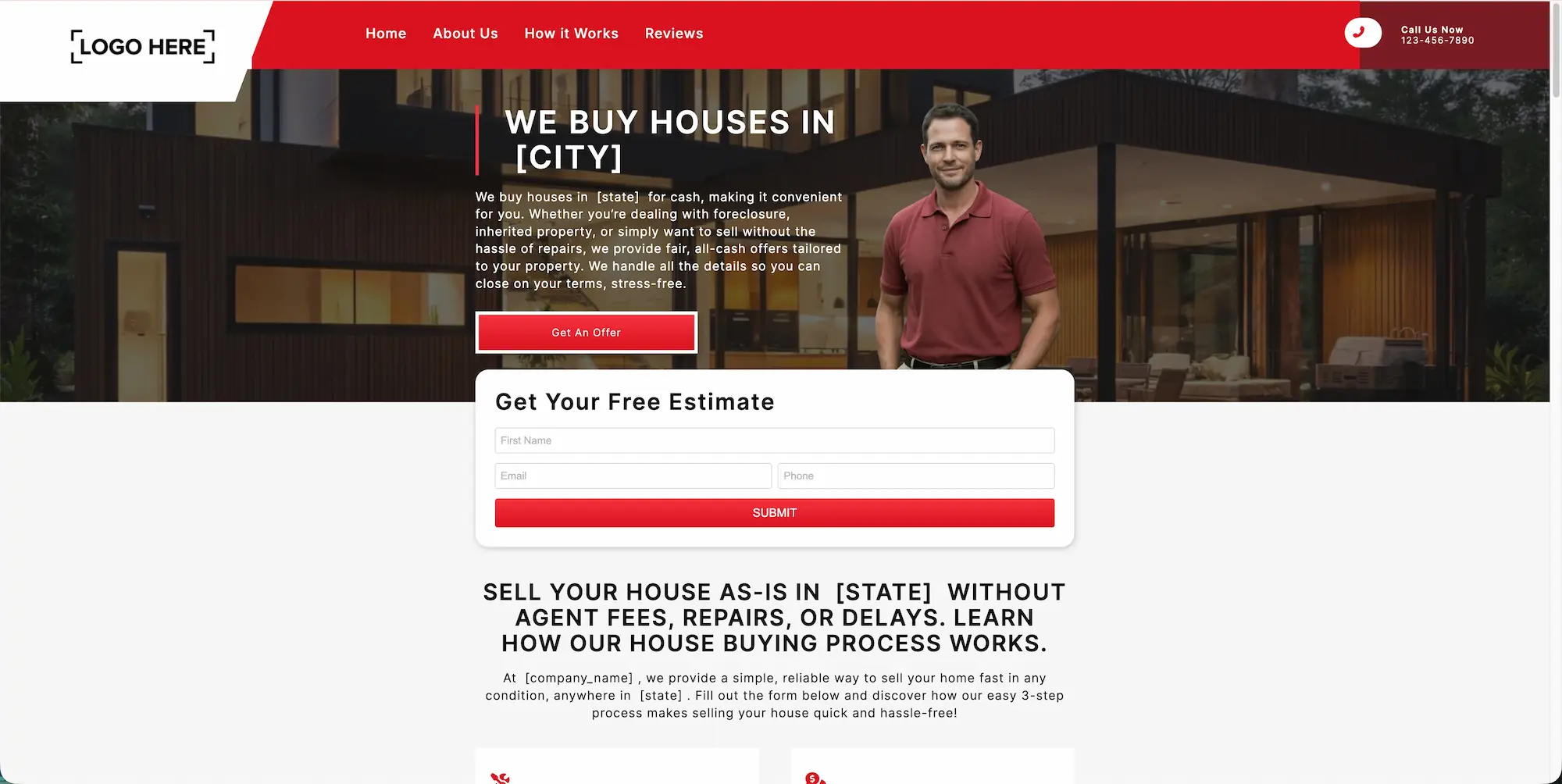
Right now, your generic “We buy houses in [City], [State]” homepage is trying to resonate with people trying to avoid foreclosure, tired landlords, probate, tax liens, and more. Trying to be one size fits all will only result in resonating with none.
Apex Vivus pages ask the seller to choose what they are dealing with. This is not you asking the seller to do extra work as a favor to you. On the contrary — the seller feels like you are the expert, experienced and knowledgeable in their situation. That builds trust, because the seller feels like you actually understand their situation.
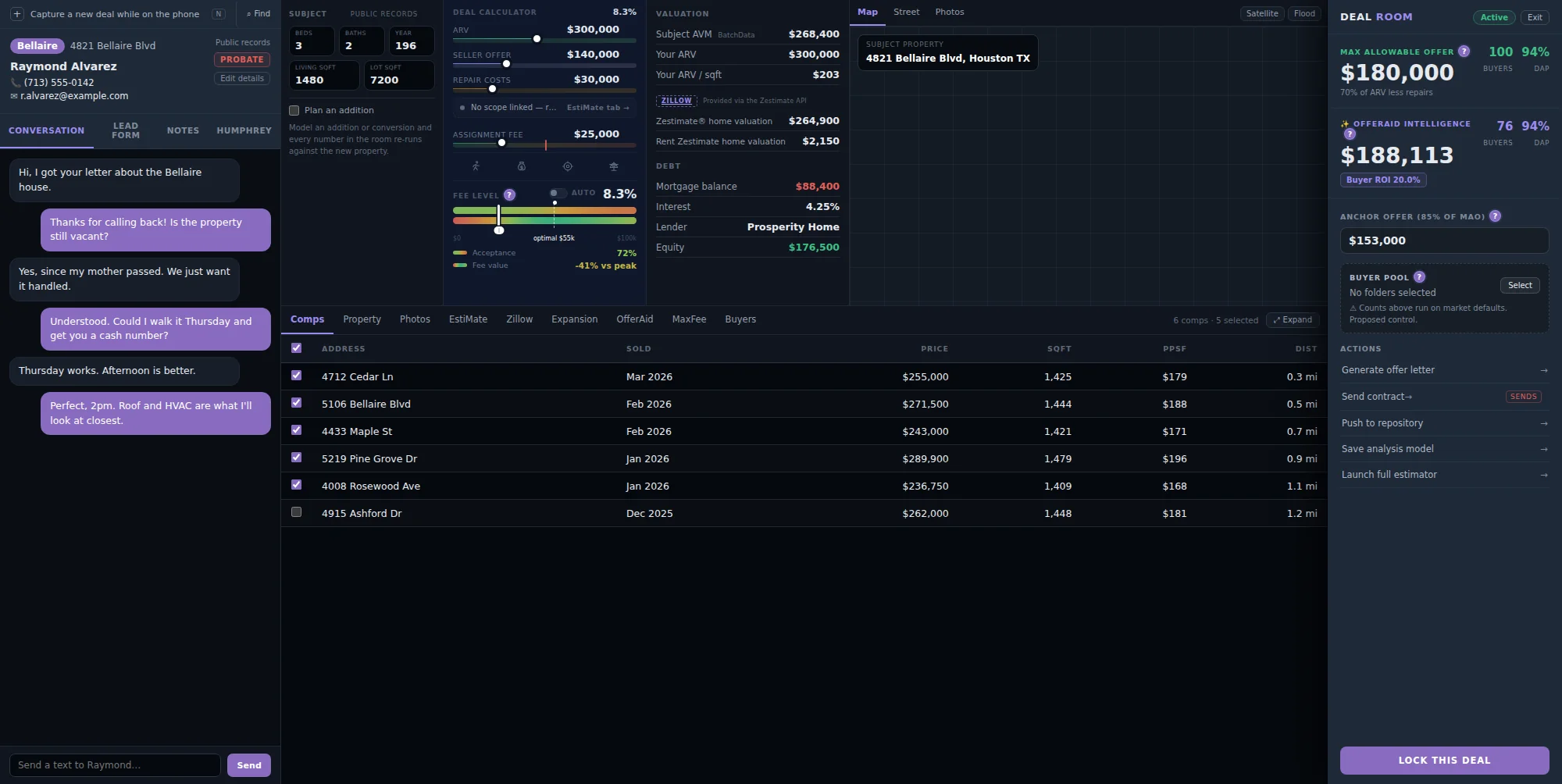
An overwhelmed widow gets one follow-up. A distressed landlord gets another. Same product, completely different conversation. The CRM scores the lead against your buy box, routes it, opens the pipeline — and starts EstiMate, Deal Room and OfferAid at the same time, each with the kind of data it actually needs.
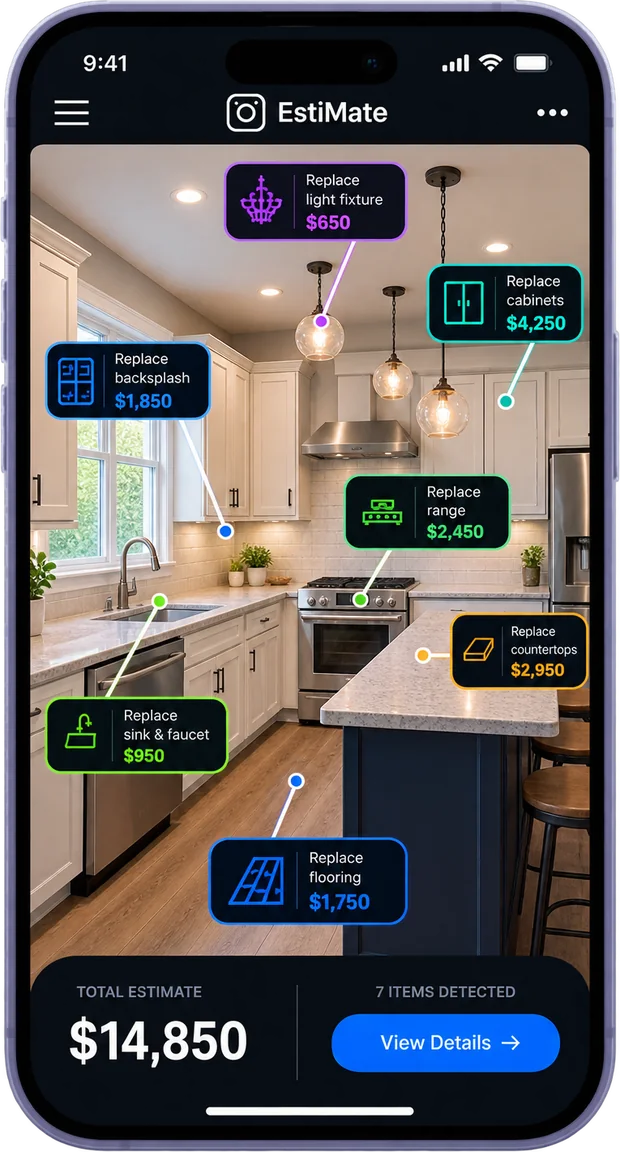
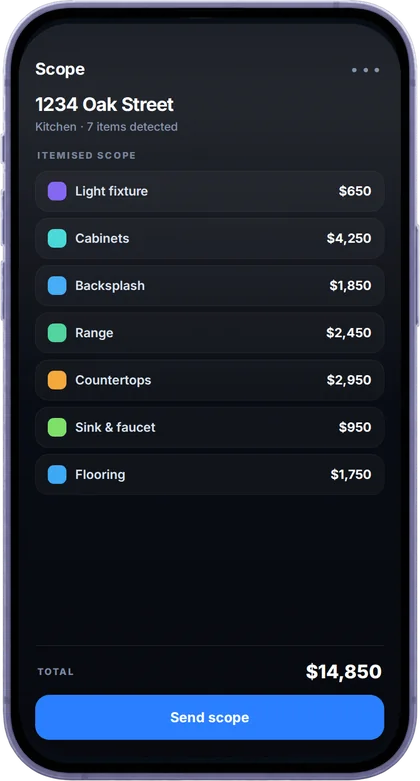
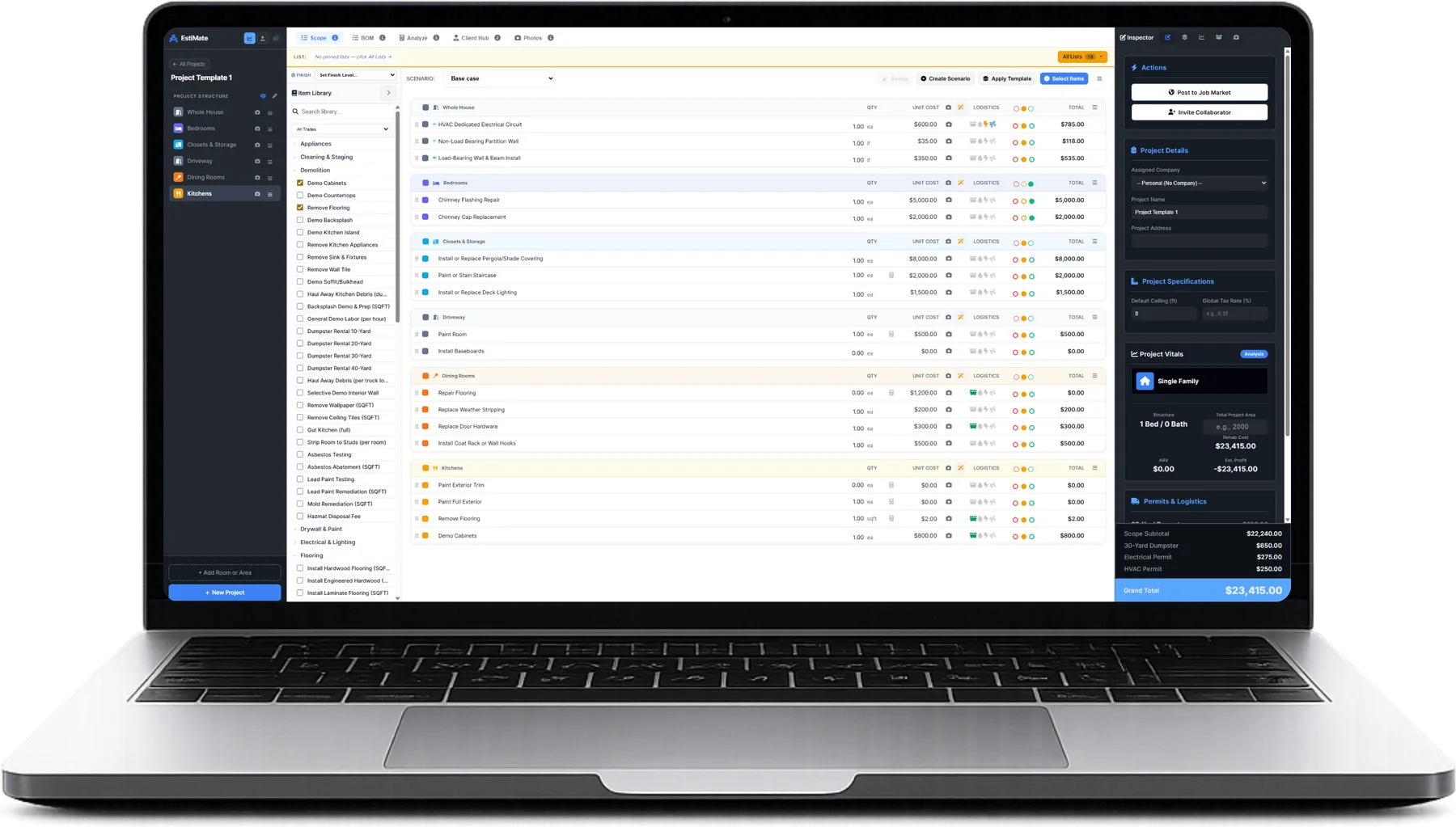
Walk the property with your phone or ask the seller to upload pictures directly onto the website. EstiMate reads every repair off your photos as you take them and prices each one against your own contractor’s numbers — line by line, room by room, while you are still standing in it.
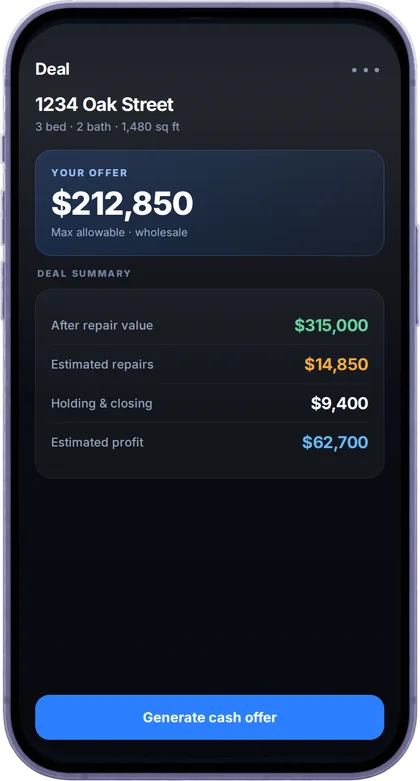
No slides and no sped-up footage. One kitchen, one pass with the camera, and every repair detected and priced as it comes into frame. Comps and ARV are pulled while you are still on site; a sendable cash offer exists before you leave the driveway.
Get EstiMate on Google PlayDumpsters, permits, dump fees, consumables. Painter’s tape, drop cloths, caulk and fasteners. If the job needs it, it is in the estimate before you reach the driveway — not discovered halfway through the rehab. Priced against your contractor rates and your market, not national averages.
From the address alone, Deal Room pulls together everything an operator would normally spend hours assembling: ARV and comparable sales, rent estimates, neighborhood and map intelligence, market conditions and transaction history, nearby investor activity. EstiMate is finishing repair cost. Deal Room is finishing market value. Both run while you walk the house.
Stop guessing what to offer.
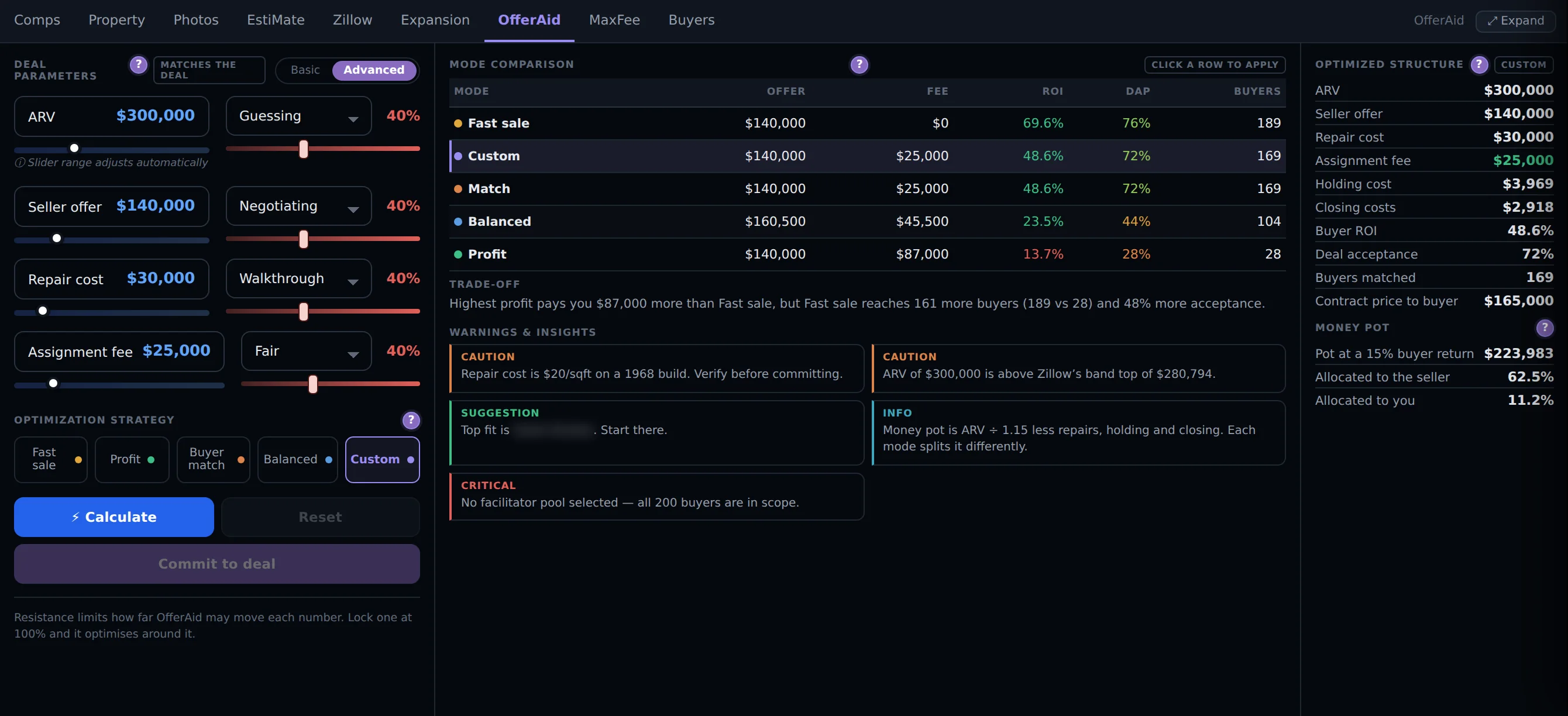
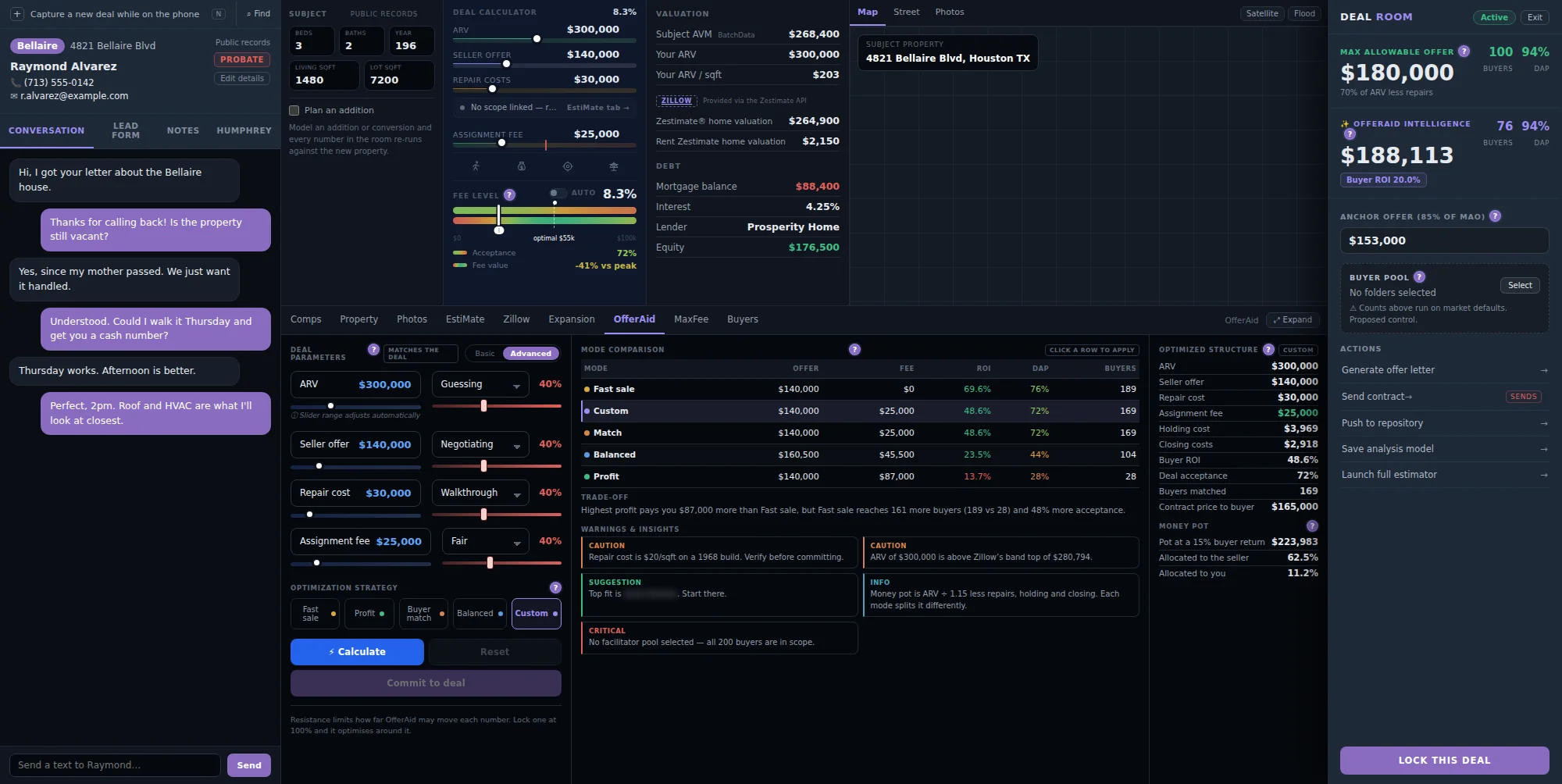
Buyer Match tells OfferAid what real cash buyers will actually pay for this property. OfferAid works backward from that number — through your repair cost, the ARV and your fee — and shows you what you can safely offer the seller.
Want a bigger fee? A faster sale? A stronger offer to the seller? Pick what matters and OfferAid rebuilds the rest around what the buyer market will support.
Tell OfferAid where each number came from. The more reliable it is, the less OfferAid will change it — use the sliders to say which numbers it can move and which it must leave alone.
Choose what matters most on this deal. Want the highest fee? A stronger offer to the seller? More margin for the buyer? Tell OfferAid what to protect and it rebuilds the rest around what buyers will actually pay.
It warns you when your numbers look risky — a repair figure that is low for the age of the house, an ARV above what the data supports. And if you haven’t chosen your own buyers, it tells you the acceptance numbers may be too optimistic.
Now you know what you can offer the seller, what you make, what the buyer pays, and how likely your matched buyers are to take it. Save scenarios to compare them, then send the one you want ahead to MaxFee, Buyer Match and DealDRAFT.
Stop picking a fee because $10K, $15K or $20K sounds about right.
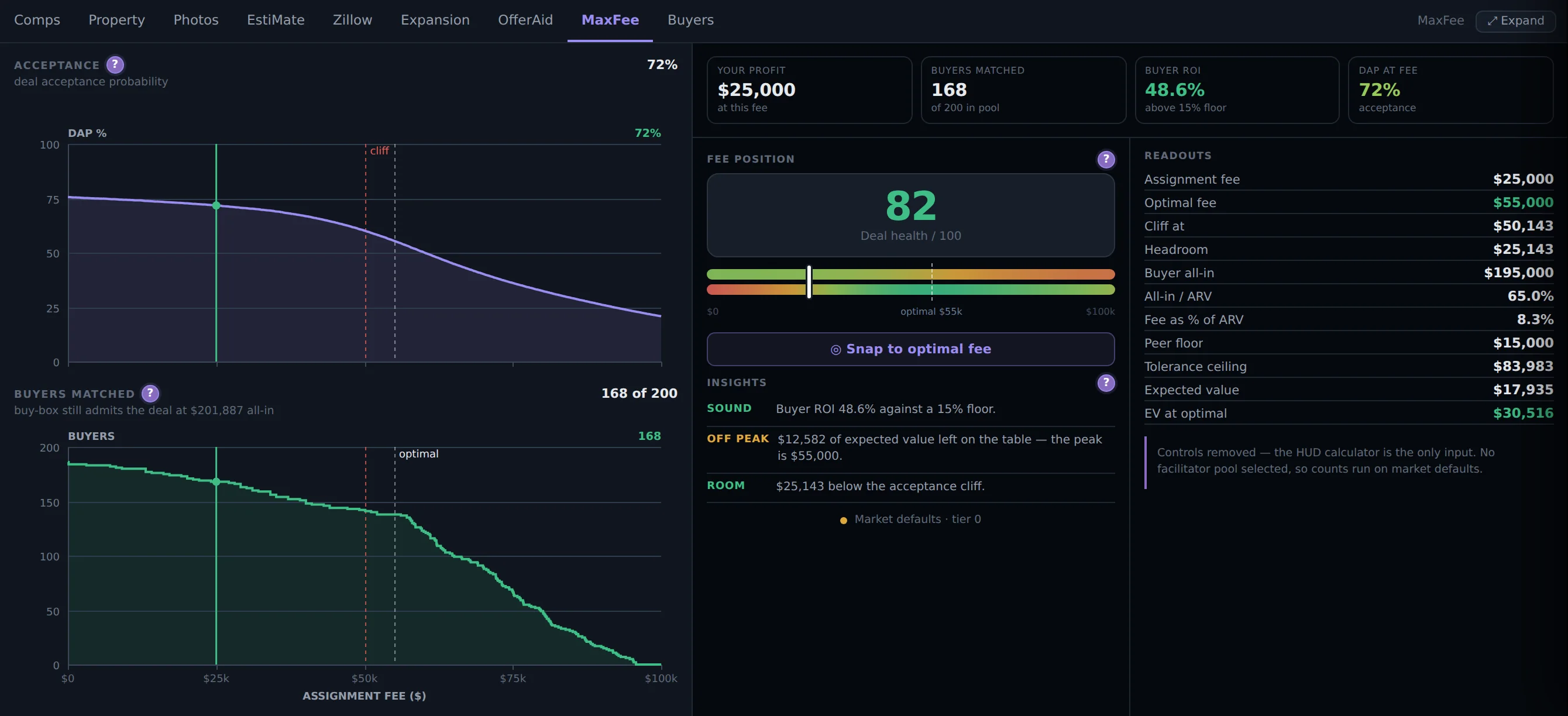
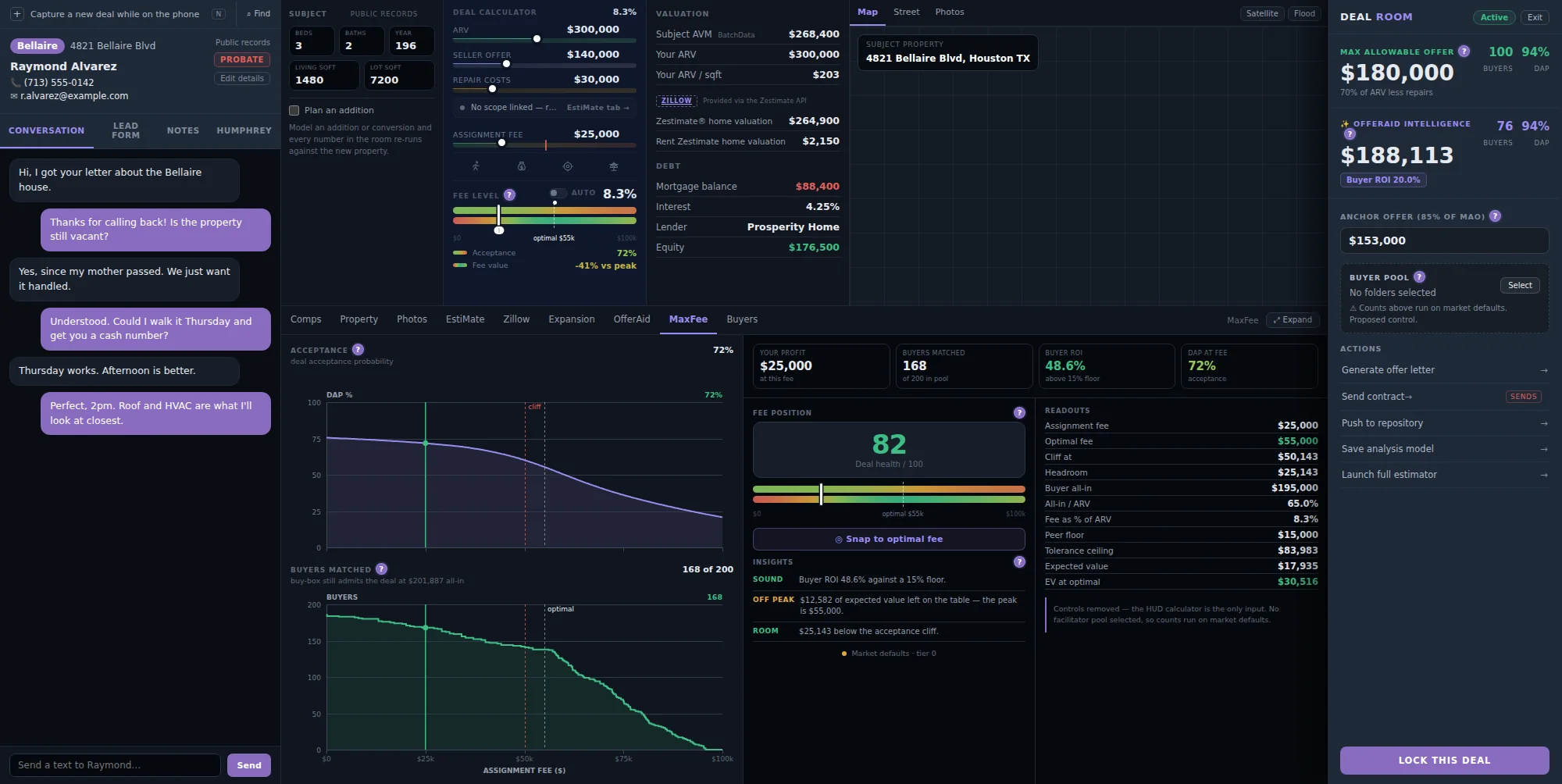
Move your fee up and watch what happens to your buyers. MaxFee shows how many are still in at every number, and exactly where raising it further starts costing you more buyers than it earns you dollars.
The graph shows exactly where raising your fee starts costing you buyers. On this deal you are still leaving money on the table.
Deal health 82 of 100 at $25,000. The readouts say where you stand: the cliff at $50,143 and $25,143 of headroom to it; the optimal fee at $55,000; buyer all-in $195,000, 65% of ARV; the peer floor and the tolerance ceiling. Off peak, it tells you what you’re leaving on the table. Snap to the optimal fee, or apply this one to the deal.
Stop blasting ten thousand “cash buyers” and hoping.
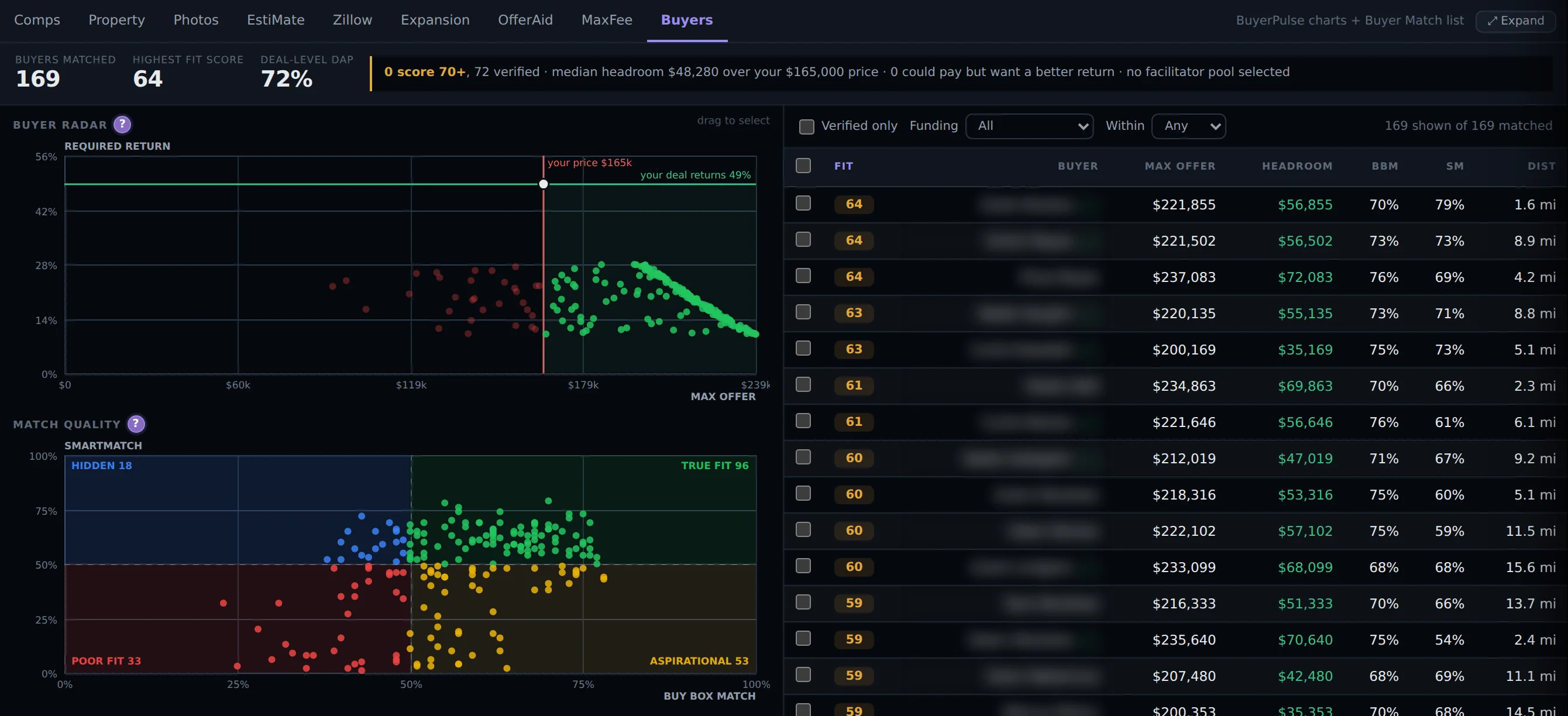
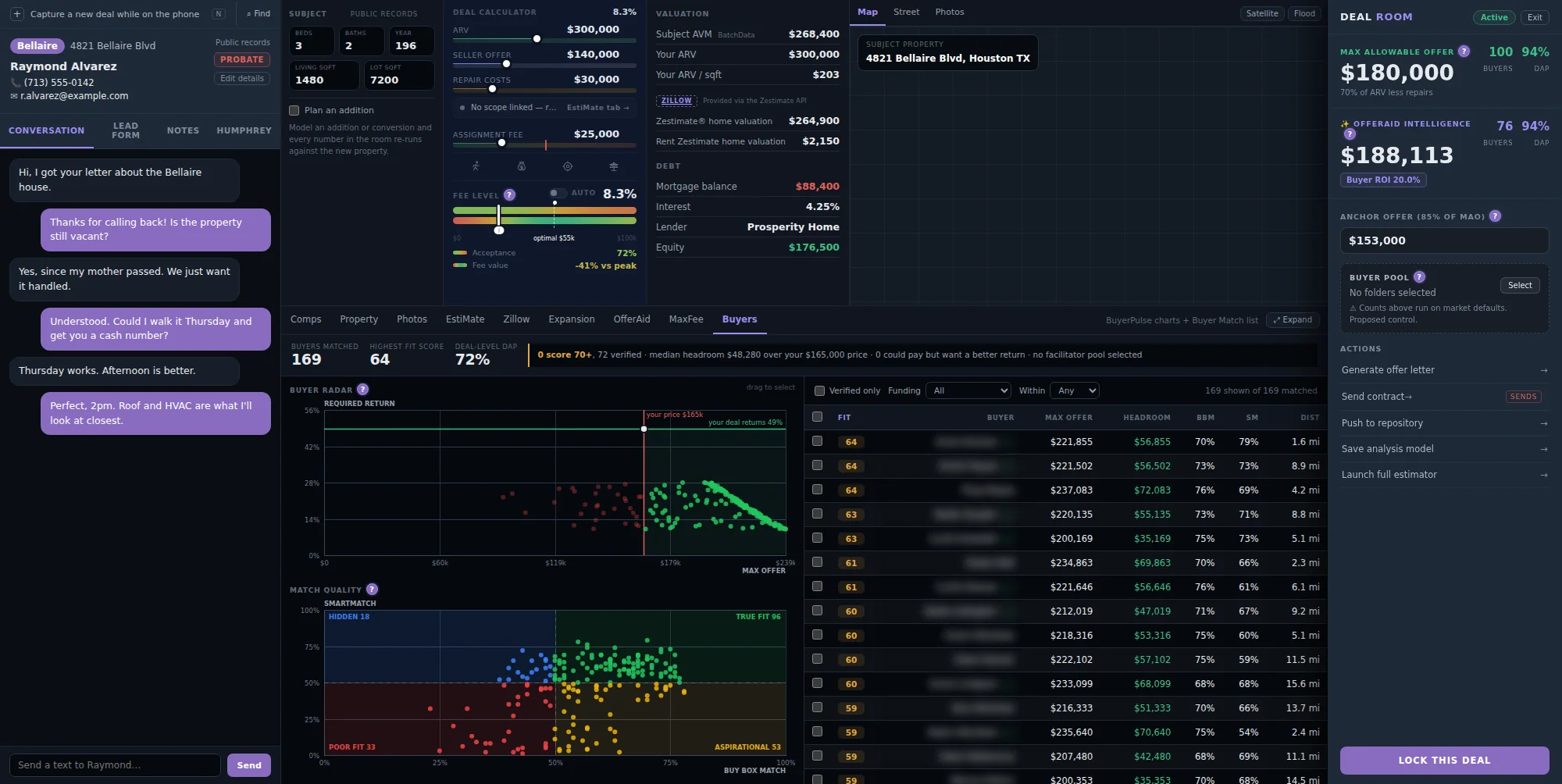
Buyer Match shows you who can actually afford this deal, who has already bought properties like it, what they can pay, and who to call first.
See what every buyer can actually pay for this property and still hit their return.
Start with the buyers who both say they want a deal like this and have actually bought one. They are your first calls. Next come the quiet ones — buyers whose history says yes even though their stated criteria say no. The rest can wait.
Every matched buyer, side by side: whether they are verified, how they fund, the most each could pay, and how much room that leaves above your price. Select the ones you want and send it.
Seller history, scope, comps, MaxFee math, the seller-facing offer, photos, documents and the matched buyers — all on one continuously updating page. It is the same Deal Room that opened when the lead arrived; you never had to rebuild the deal — everything you already did is here. DocuSign is one click from here.
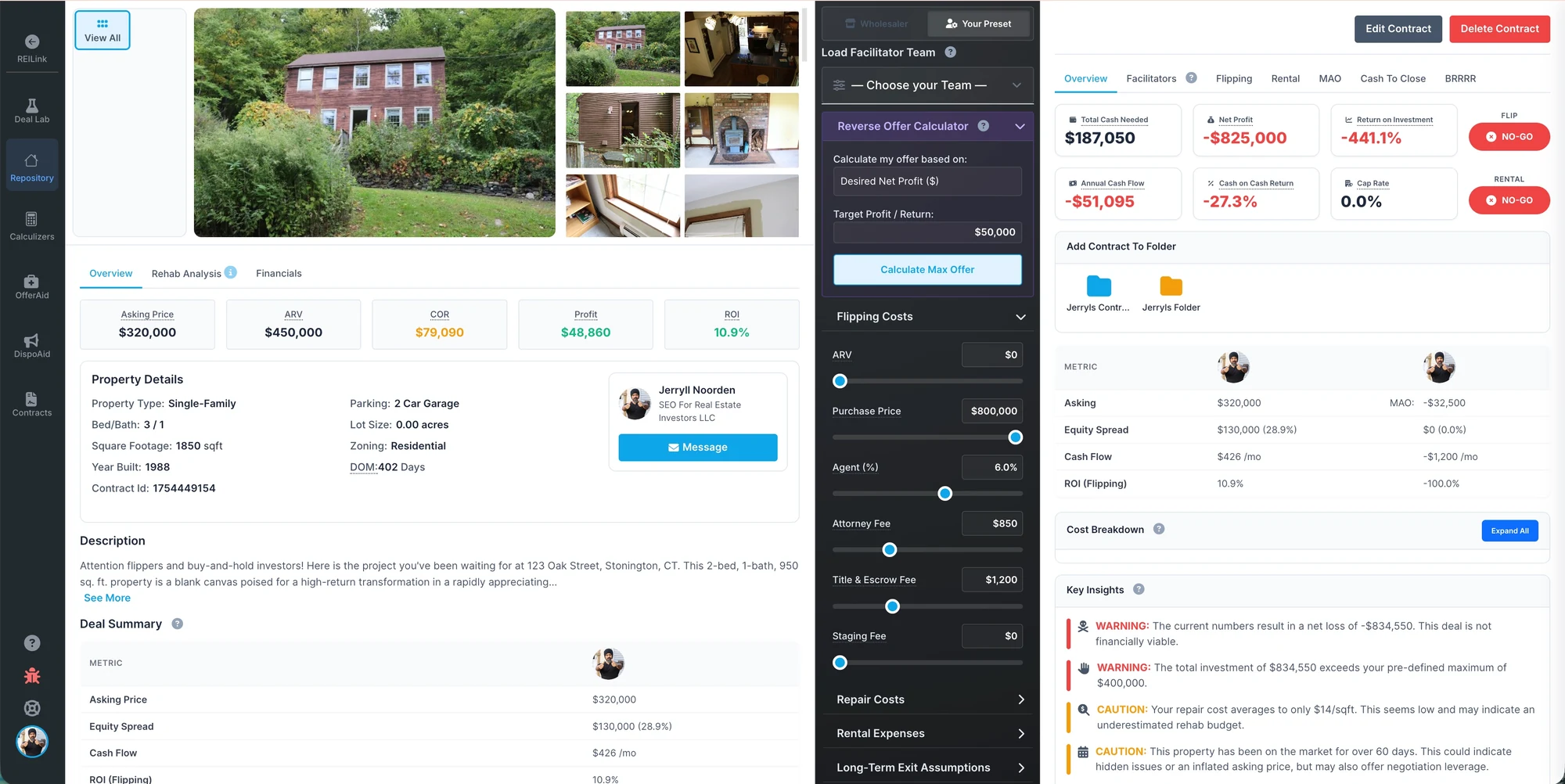
Repository routes the packaged deal on what buyers historically actually purchased — not their stated buy boxes. Each buyer opens a deal page built for them: the wholesaler’s asking price, ARV and repair budget on the left as the baseline, the financing, costs and assumptions in the centre, and their own profit, ROI and cash needed on the right — updating as anything moves.
Don’t trust the wholesaler’s numbers. You don’t have to.
Repository pulls its own comps, uses the real EstiMate repair scope, and runs the deal with your financing and your actual costs. A deal that looks GO-GO on the wholesaler’s numbers can come back NO-GO on yours — and it is already done when the page opens.
Two buyers can buy the same house and never flip it for the same profit: different agents, contractors, lenders, appraisers. So the deal page runs on your people. Click Load Facilitator Team and pick a folder — your go-to crew — and everyone in it appears with their rates. Click Pick the Best: it selects the most cost-effective professional in each category — lowest fee; for lenders lowest rate, then fewer points — and Change one assumption and profit, cash needed and ROI update immediately.
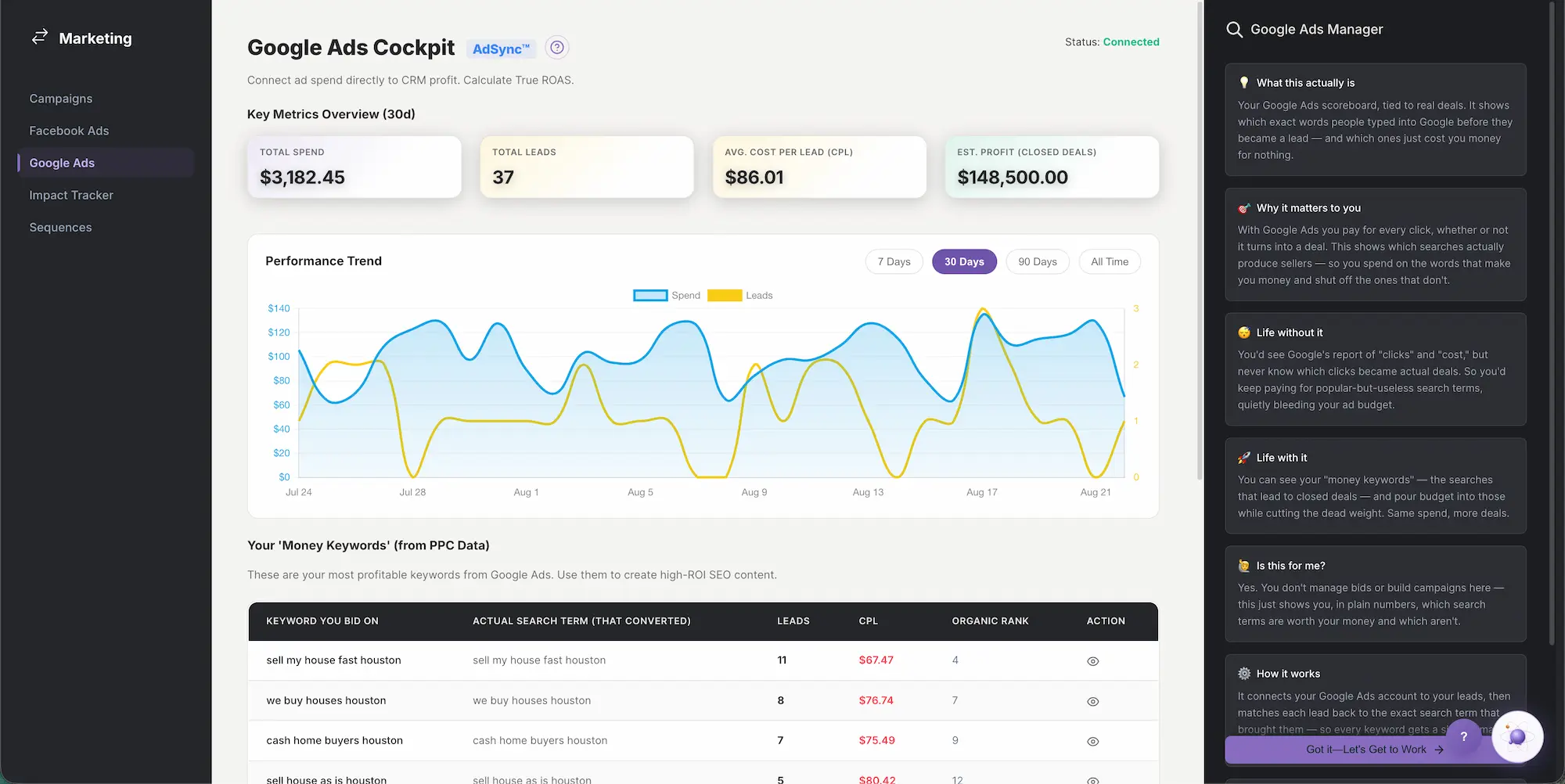
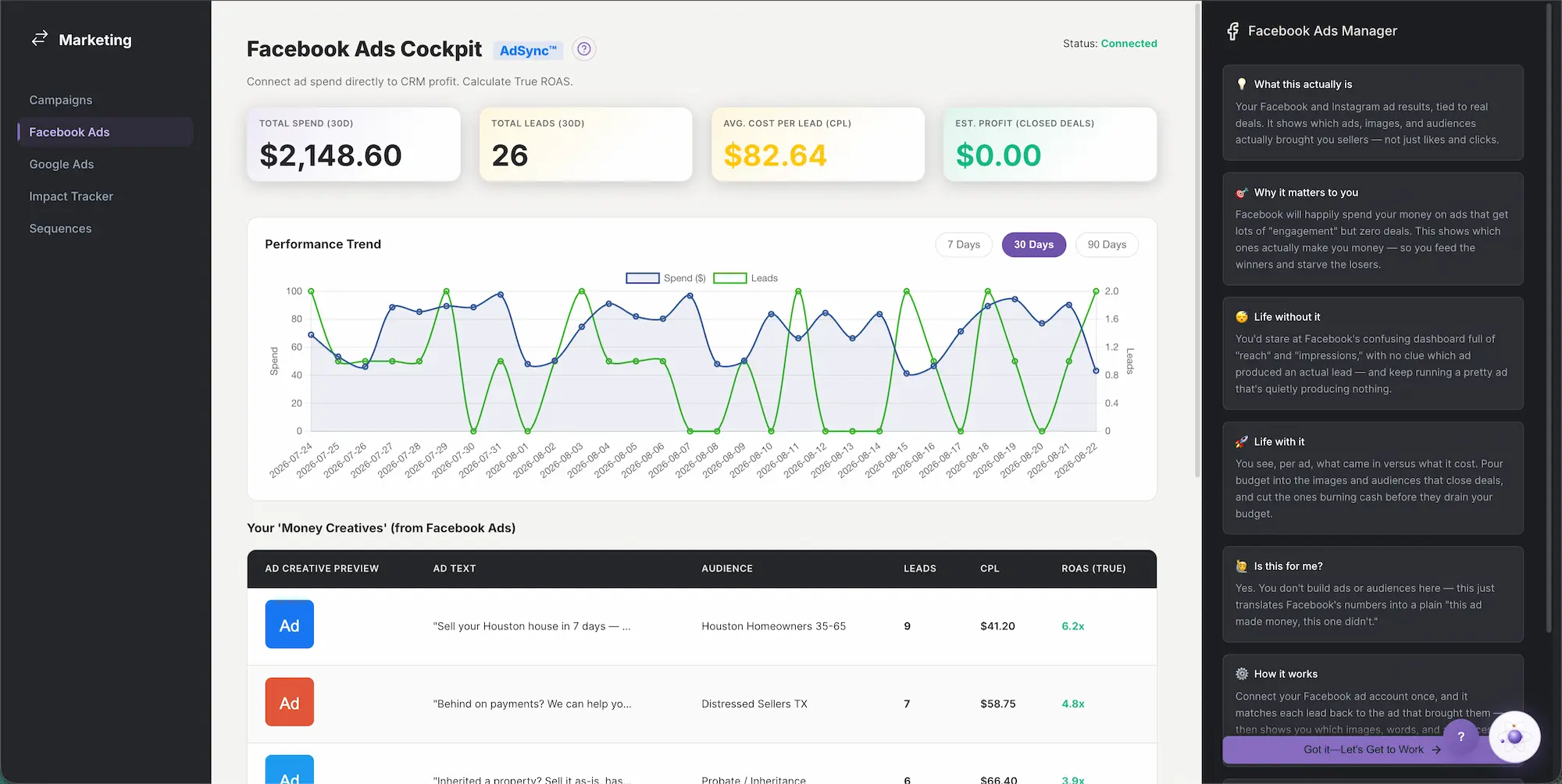
When the deal closes, Apex shows you exactly which ad, which keyword and which page produced the money. You stop optimizing for clicks and start optimizing for closed revenue.
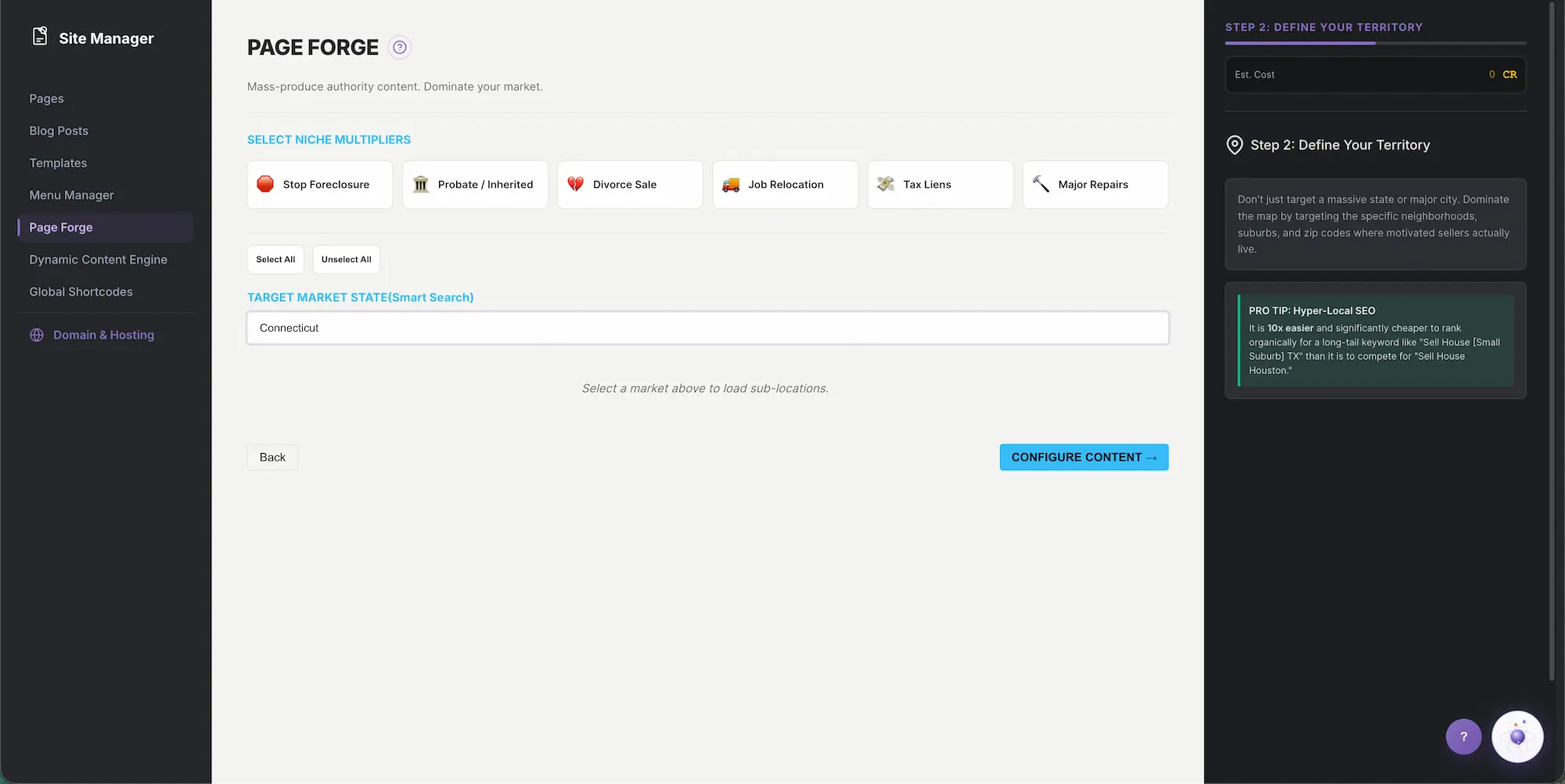
AdSync found the keyword, the geography, the seller type that actually closed. PageForge builds SEO pages aimed at exactly that pattern — so the next homeowner from that source arrives as organic traffic, not a paid click. Not generic content: pages built around where the money actually is.
Apex remembers what actually happened. Which repair estimates were right. Which offers got accepted. Which buyers closed. Which ads and searches produced profitable deals. Then it uses that on the next property, the next offer, the next buyer match and the next seller page. The more real deals you run through it, the better it knows your business.


Wholesalers, flippers and dispo leads on what changed when the next step was already done.
OK so, I’m sitting here in my truck just laughing, looking at my phone, having just finished a walkthrough. Any other day, I’d be driving home, spending the next 4 hours figuring out how to make this deal work.
I feel like something is missing or wrong, because I am done. I mean done. Already. Offer sent.
This is so insane, I just want to tell someone. So I figured I’ll write this review instead. That should tell you something.
I don’t think anyone can understand this feeling unless they experience it. Not only is the work done, which is obviously great, but knowing I sent that offer with buyers already matched, interested in buying this contract.
This thing is sick!
The little shit is what kills you on rehabs.
Everybody sees the kitchen. Everybody sees the flooring. Then somehow you’re $12k over budget because of 40 things that were ‘only’ a few hundred dollars each.
I walked one of our current projects with EstiMate just to test it and started laughing when I saw how much crap it was adding.
THAT is what I need it for.
You know that feeling when you get a contract signed and you’re excited for about 10 minutes and then realize shit, now I actually have to sell this thing?
Yeah.
The buyer part just removed a whole lot of that anxiety for me.
My first reaction was actually irritation.
I’ve spent years building spreadsheets for this stuff.
I put a property in and started going through everything it had already pulled together and I’m like… are you serious? I have literally been doing this manually for years.
The fee thing fucked with my head a little bit.
Because now I’m thinking about every deal where a buyer said yes immediately.
How much money have I left on the table?
PLEASE make wholesalers use this.
I can’t tell you how many ‘deals’ I get where the ARV is basically made up and repairs say $35k with absolutely nothing showing me where $35k came from.
If somebody sends me a property and I can actually see what needs to be done and the numbers make sense, I’ll look at it.
You’re making my job easier too.
I think what got me was realizing I wasn’t waiting on it.
I’m walking the house and it’s doing its thing. Meanwhile the other stuff is already getting done.
I’m so used to everything being: finish this, open something else, copy the address, put the numbers in again, do the next thing.
This felt weird the first time because I kept thinking I was forgetting to do something.
We have 11,000 cash buyers.
You know how useful that is when you actually need to sell a house?
Not very.
Half don’t answer, half haven’t bought anything in forever and then we blast everybody until somebody bites.
Seeing who actually makes sense for the property is probably the first time I’ve looked at our giant ‘buyer list’ and realized how stupid the way we’ve been doing this is.
I found out one of our deals came from something I thought wasn’t working.
That’s all I needed to see.
We’ve been making marketing decisions off leads this entire time. I don’t give a shit which campaign gives me the cheapest lead anymore. Show me which one gives me deals.
I’ve been doing this long enough that when somebody shows me new real estate software I usually know what it is within 30 seconds.
CRM. Comp tool. Buyers list. Whatever.
This one took me a minute.
Then I realized why.
I kept waiting for the part where I had to take what it gave me and go do the next thing somewhere else.
That part never came.
That’s when I got it.
Every step from the first lead to the signed contract, already done by the time you would normally start. That was not a preview. That is the product.